What a Story Continuity Tool Has to Fix at Series Scale
It is book four, chapter nine. You are nine hundred words into a scene that is finally working, and your protagonist reaches for a name she may not be allowed to know yet.
Not does she know it — you are fairly sure she does. The question is when she learned it, and from whom, because if she got it in book two from somebody with a reason to lie, the line you are about to write is a different line and the scene tilts around it.
So you go looking. The character sheet tells you what is true. The series notes confirm she knows. Neither tells you which scene put it in her head, and that scene is the only thing that settles it. Four books, three note documents, and a search box that wants the exact word you chose eighteen months ago.
You find it eventually. It costs you twenty minutes and the scene.
Why does continuity break in a long series?
Continuity does not break because you stopped keeping notes. By book four you almost certainly keep more notes than you did in book one. That is the shape of the problem, not the cause of it.
It breaks because of a mismatch between two numbers that move in opposite directions.
The first is what a single continuity lookup costs — the distance between having the question and having an answer you would stake a scene on. The second is what you can afford to spend on one mid-draft, while the scene is still warm under your hands.
The first number grows with the corpus. The second one does not. It is fixed by something outside your control: how long a half-written scene will sit still and wait for you before it stops being the scene you had in your head. Every working novelist knows roughly what their own number is, and nobody's gets bigger with experience.
Everything below follows from those two curves and where they cross.
A story bible answers a different question than the one you have
A story bible is very good at what is true. Her eyes are grey, the northern treaty holds until the second winter, the brother is dead. Facts, in their current state, in one place you can look.
The questions that actually stop you mid-scene are not shaped like that. They are: when did this become true, and where did I put it in print?
Those are questions about establishment, not about state. When she learned it. Which scene set it. Whether it was narration or a line of dialogue spoken by somebody unreliable. Whether you established it twice, slightly differently, and which of the two a reader is more likely to remember.
A bible entry reading she knows about the money cannot answer any of them, because the establishment is not a property of the fact — it is a location in the manuscript. The habit that helps is recording what changes and where you established it, and it is genuinely the right habit: it is the only version of note-keeping that turns a later check into something you can actually perform.
It is also necessary rather than sufficient, and it stops being sufficient at a fairly predictable point, for a reason worth being precise about.
Why the wall is arithmetic, not discipline
Take the note-keeping as given. You did the work. Every meaningful change has an entry, and every entry has a chapter beside it.
You still have to find the entry. And finding is where the size of the corpus lives.
Inside one book the search space is small enough that you often skip the search entirely — forty chapters, a dozen pages of notes, and a decent chance you simply remember. Across four books, the candidate places a given answer could be hiding scale roughly with how much you have written, while the fraction of it you can hold in working memory does not. Your recall covers something like a rolling window of recent work. The corpus keeps growing behind that window.
Then two effects compound on top of the first.
The questions themselves get harder. A question raised in book one can only be answered by book one. A question raised in book four can be answered by any of the four, and the ones that matter most — what she knows, what she owes, who she has forgiven — are exactly the ones with the longest reach.
The expensive questions get more frequent. The longer a cast has been alive on the page, the more of its present behavior depends on something established a long way back.
So the cost per lookup rises, the number of lookups rises, and the budget stays where it has always been. At some corpus size the typical continuity question costs more than the scene can afford to wait — and past that point something changes that matters more than the delay itself.
You stop looking things up. You guess, or you leave a bracket, or you write around the question so it does not have to be answered today. That is where the error gets in. Continuity errors in long series are very rarely memory failures. They are deferred lookups that never came back.
That is why this is arithmetic and not discipline. Nobody has ever fixed a crossing point by trying harder. You fix it by changing one of the two numbers, and only one of them is available.
The two obvious fixes, and why neither moves the curve
A bigger, better story bible. More thorough entries, more cross-references, a fifth document to hold what the fourth outgrew. This raises the ceiling on what you could find. It does not lower the cost of one lookup — and by adding another place to look, it frequently raises it. A more complete record still requires you to know which document, which entry, and which of two slightly different versions of a scene you are half-remembering.
A context-blind assistant. Paste the relevant chapters into a chat window and ask. The trouble is the word relevant: knowing which chapters bear on the question is the lookup, so this fix quietly assumes the thing it was meant to do. And a window that holds more is still a window that ends — that ground is already settled, and this post is not about the model's memory at all. It is about yours, and about what it costs you personally to answer one question about your own book.
If you are shopping for a story continuity tool, that is the number to judge it by. Not how much it can store. What it costs to get one answer, mid-scene, on book four.
What actually lowers the cost of a lookup
Sagaly is the AI-native fiction writing application for the modern author. AI-native here means agentic, not generative: the point is an AI that reads what you have built before it answers, not one that produces prose on request.
What changes the arithmetic is making the corpus itself queryable by meaning, over structure you were already keeping.
Sagaly will model your story as a typed hierarchy —
Universe > Epic > Series > Story > Act > Chapter > Scene — and Character,
Relationship, and Tag will be typed Properties on the elements they belong to
rather than rows in a document sitting beside the book. That is the substrate,
and it is the same argument as
what makes a fact addressable: a detail
with a place to live can be asked for, and one buried in a paragraph cannot.
On top of it, two things will do the actual work.
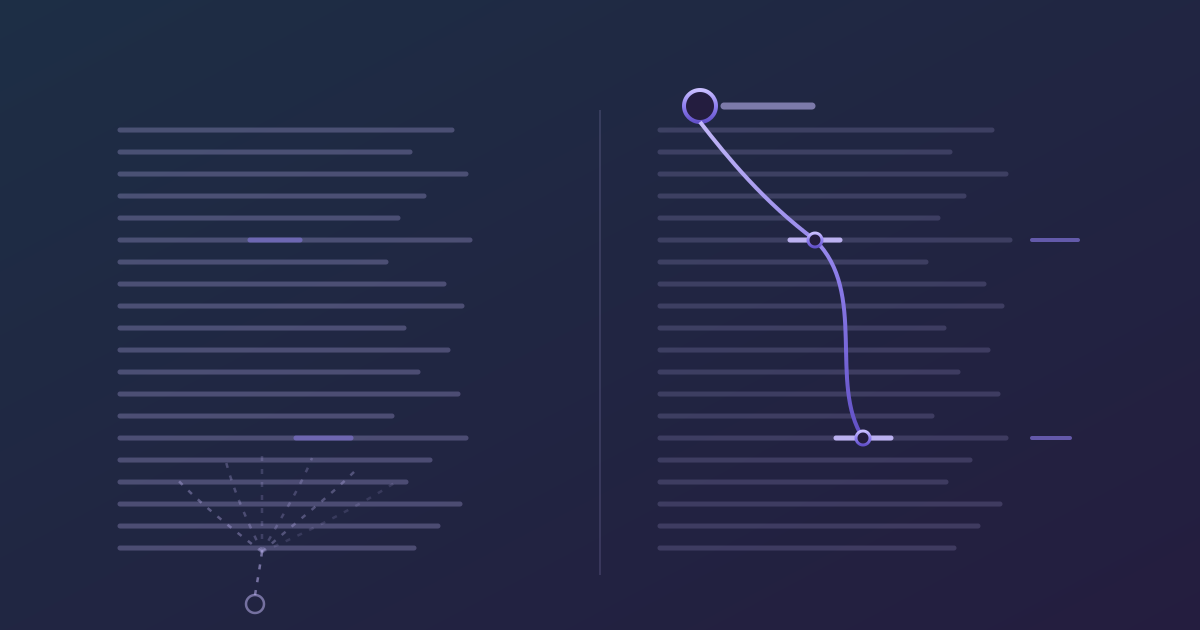
You will be able to search the whole story by meaning rather than by string, so the question when did she learn about the money will no longer require you to first recover the exact phrasing you used in book two. And the collaborator will read the elements that bear on your question before it answers, and it will cite the ones it read, so you will be able to open the scene an answer came from and judge the establishment yourself rather than take a summary on faith.
Ask your story a question — and Sagaly will answer from your own canon.
What that does to the two curves is the whole point. A search by meaning does not much care whether there are forty chapters behind it or four hundred, so the cost of a lookup will stop climbing with the size of what you have written. The budget stays fixed, as it always was. The other line will stop rising to meet it.
Sagaly is designed so that structure enables intelligence. That is a statement about how the application is designed, not a report of what it does for you today. Everything in this section is being built and none of it is in your hands yet, and this blog will keep saying which is which.
About the phrase "novel consistency checker"
Search it and the category promises something quite specific: software that reads your manuscript, finds the places where you contradicted yourself, and hands you the list.
It is a reasonable thing to want and a much harder thing to build than it sounds, because a great many apparent contradictions in good fiction are not errors. A character lies. A narrator is unreliable. A fact changes on purpose in chapter thirty and the earlier text is meant to read as superseded. Anything that cannot tell those apart from real mistakes produces a list you learn to ignore by the second week, which is worse than no list.
Asking is the tractable first step, and it is the step that pays down the arithmetic above. A question you have asked is bounded — it names the character, it names the thing, and the answer is a scene you can open and read. Sweeping a whole manuscript for contradictions nobody has asked about is a different and much larger problem.
So, plainly, in our own voice: automated consistency checking is direction for Sagaly, not release one. It is where this is pointed. It is not what ships first, and it is not something to choose a tool on today. What release one aims at is the lookup — making the question cheap enough to ask while the scene is still warm, so that the deferred lookup that becomes the error stops happening. Asking and checking are different products, and we are not going to let one stand in for the other.
Where this goes, labeled as direction
One paragraph of destination, marked as destination rather than as anything shipping: further out, the elements themselves will remember — a cast that will remember what it went through, each from its own vantage, rather than sitting still and waiting to be read. That is the point at which continuity stops being a retrieval problem at all.
That is not release one, and we will not dress it up as release one. What is worth taking from today is smaller and more useful. The reason your notes stopped holding at book four is not that you got worse at keeping them. It is that the question got expensive and your working budget never did. You are the author, the cast is yours, and the only thing that needs changing is what it costs you to ask.